← Knowledge · Updated 6 November 2026 · 6 min read
Key points
- A peptide mix, also called a peptide blend, holds two or more peptides lyophilised together in one vial.
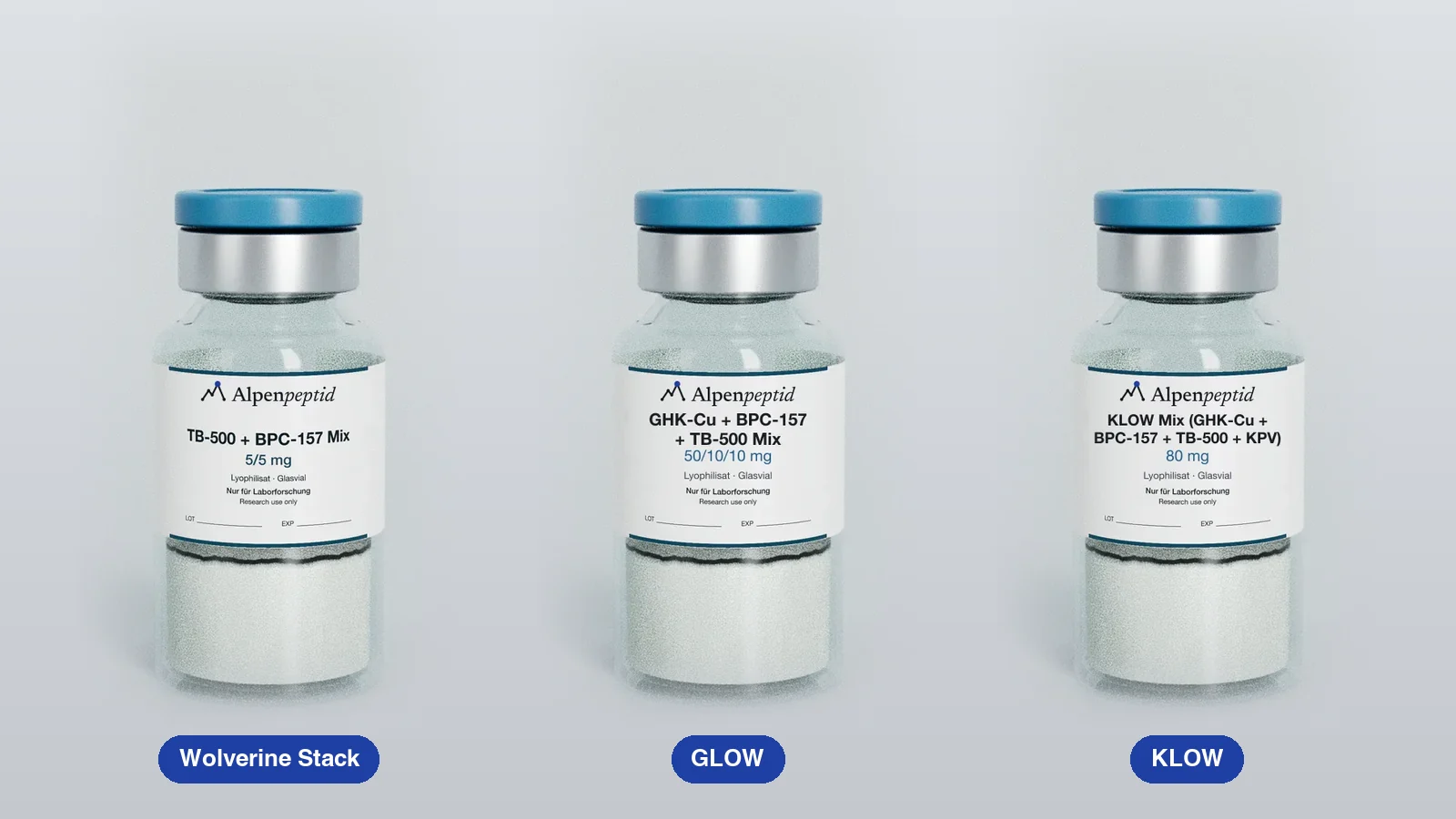
- Trade names such as Wolverine stack, GLOW and KLOW stand for fixed combinations. What counts is what the label and the certificate of analysis state.
- A figure such as “5/5 mg” gives the amount of each component. A single figure such as “80 mg” gives the total.
- Analysing a mix takes more work: each component needs its own identity, amount and purity.
- Dissolve and store a mix according to its most sensitive component.
What is a peptide mix?
A peptide mix is a lyophilisate that contains several peptides in a fixed ratio. The peptides are synthesised and purified separately, then filled and freeze-dried together. For lab work this means one vial supplies several substances at once, in the ratio the manufacturer set.
Some combinations have picked up their own names in trade. These are not chemical names but nicknames. When you compare literature or offers, always look at the peptides inside and their amounts, not the trade name. How many names a single substance can have is shown in Peptide nomenclature explained.
The well-known mixes at a glance
| Trade name | Peptides inside | Amount on the label |
|---|---|---|
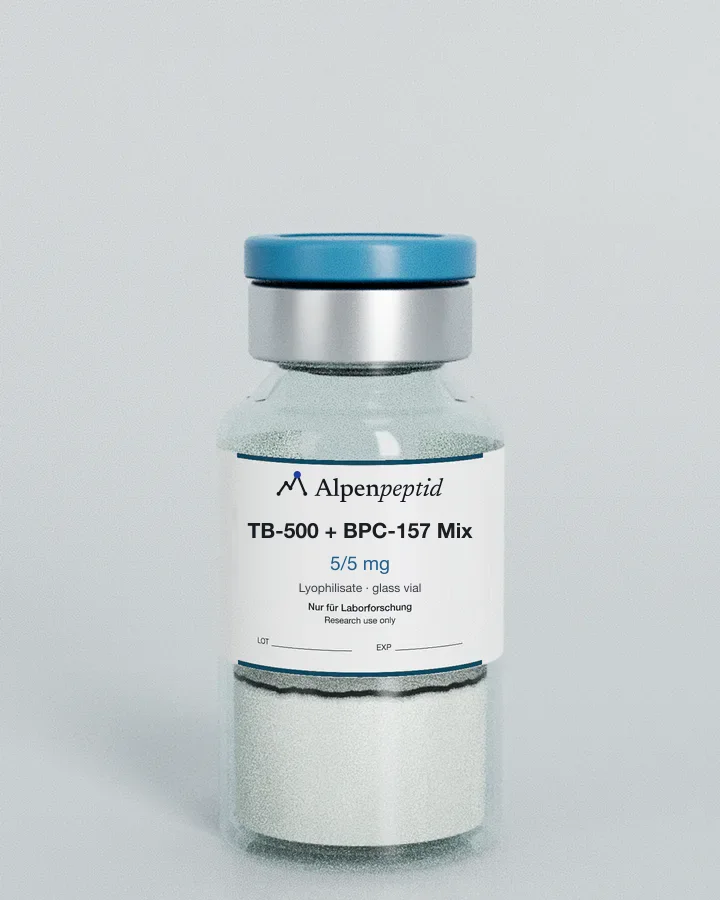
| Wolverine stack | TB-500 and BPC-157 | 5/5 mg |
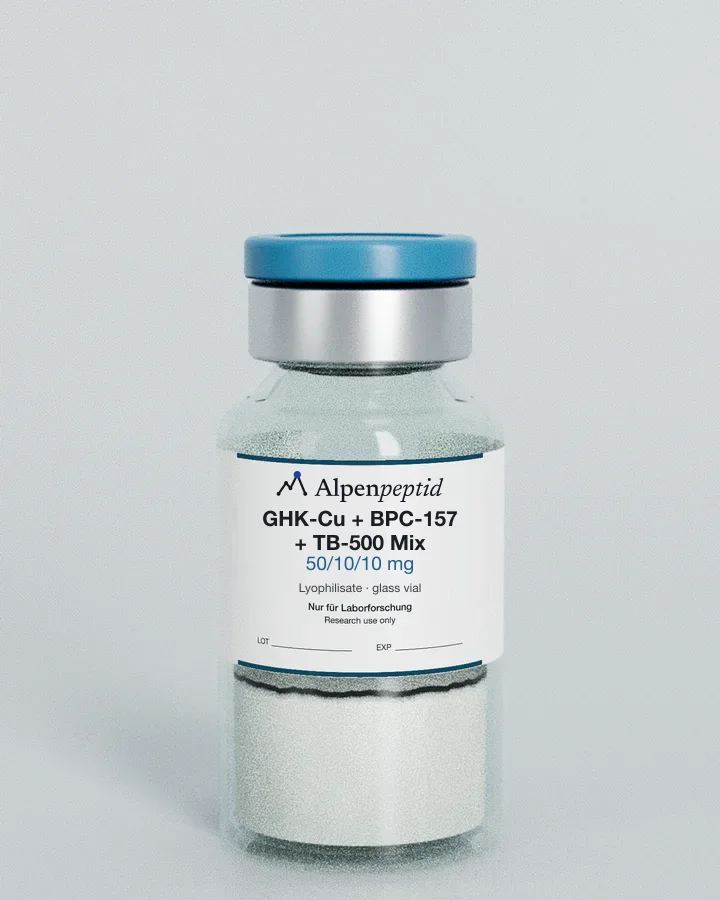
| GLOW | GHK-Cu, BPC-157 and TB-500 | 50/10/10 mg |
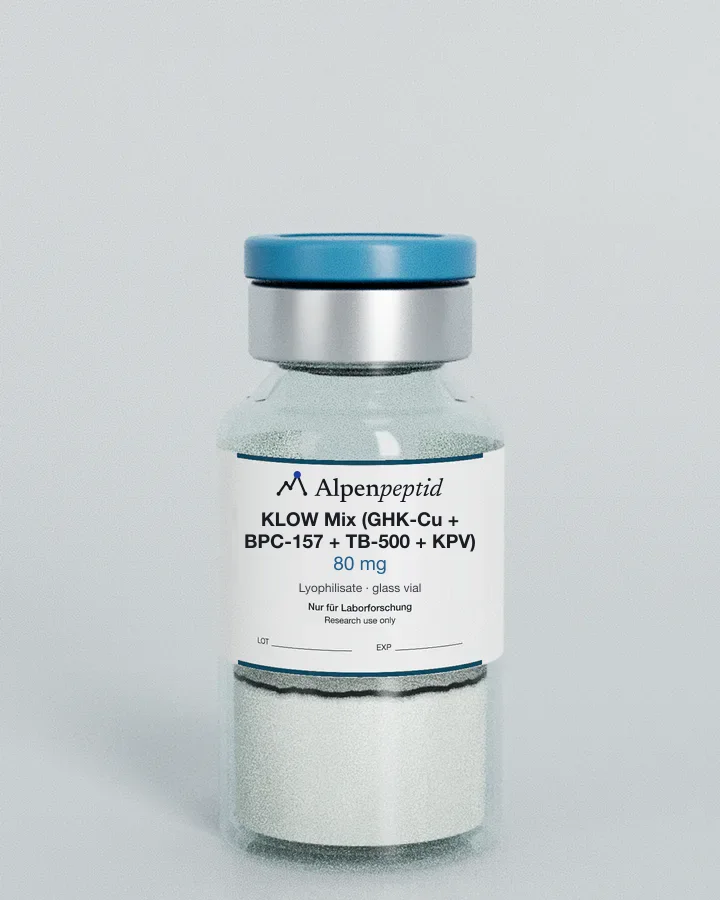
| KLOW | GHK-Cu, BPC-157, TB-500 and KPV | 80 mg total |
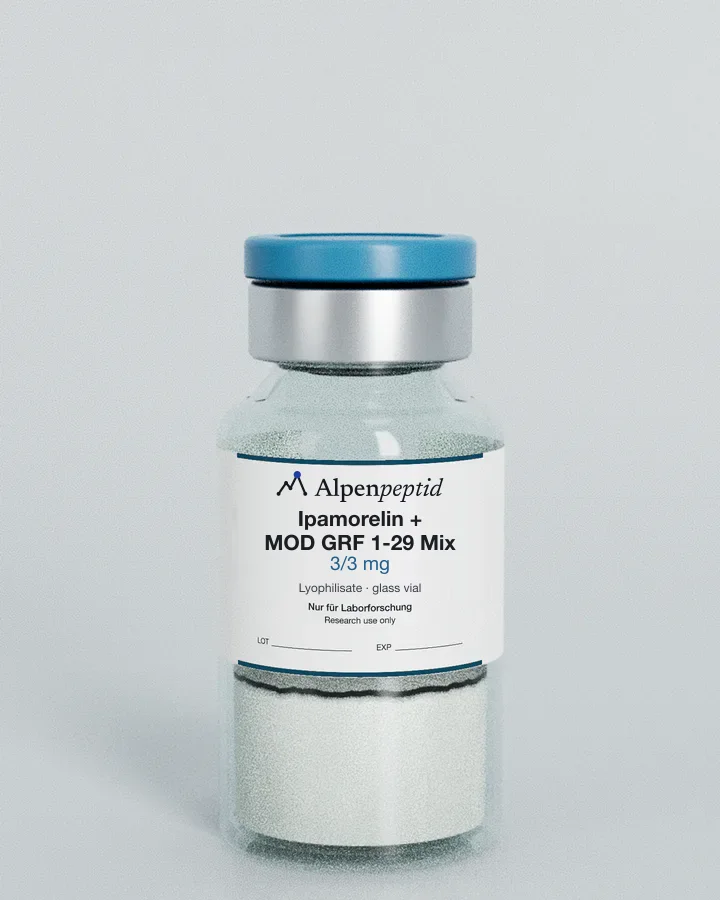
| – | Ipamorelin and Mod GRF 1-29 | 3/3 mg |
| – | Tesamorelin and ipamorelin | 5/5 mg |
| – | GHRP-2 and Mod GRF 1-29 | 5/5 mg |
| – | Fragment 176-191, Mod GRF 1-29 and ipamorelin | 5/5/5 mg |
| – | GHK-Cu and KPV | 50/10 mg |
| – | GHK-Cu and epithalon | 20/10 mg |
| – | BPC-157 and KPV | 5/5 mg |
All mixes are in the peptide catalogue, for example the TB-500 + BPC-157 mix, the GHK-Cu + BPC-157 + TB-500 mix and the KLOW mix.
How to read the amount
Mixes use two notations. “5/5 mg” means each of the two components is in the vial at 5 mg, 10 mg in total. “50/10/10 mg” means 50 mg of the first and 10 mg each of the second and third. If the label shows only one figure, such as “80 mg”, that is the total. How it splits across the components is then on the lot’s certificate of analysis.
As with single peptides, the figure refers to the lyophilisate, not the pure peptide. Counterions and residual water count too. Peptide content can differ per component, because basic peptides bind more counterions. More on this in Peptide content vs purity.
Mix or single peptides?
Both have their place. The choice depends on what an experiment needs.
| Mix | Single peptides | |
|---|---|---|
| Ratio of substances | Fixed | Free to choose |
| Number of vials | One | One per substance |
| Analysis | More work, several components | One component per certificate |
| Suited to | Experiments that study exactly this combination | Experiments with variable amounts or a single substance |
For series in which concentrations are varied one by one, single peptides are the better choice. A mix suits work where exactly the given combination is under study. The ratio cannot be changed after dissolving.
Analysing a mix
The HPLC chromatogram of a mix shows several main peaks, one per component. A single “purity” figure for the whole vial therefore says little. A good certificate of analysis for a mix gives, for each component:
- identity, shown by mass spectrometry or LC-MS,
- the measured amount compared with the declared amount,
- purity, relative to that component,
- the lot number, which also appears on the vial.
Because components can overlap in the chromatogram, LC-MS is especially useful for mixes: each peak gets its mass, so each component can be assigned clearly. How to read a certificate is shown in How to read a peptide certificate of analysis. The methods are explained in HPLC and mass spectrometry.
Dissolving and storage
A mix behaves like its least soluble component. So check the sequences of all peptides inside and choose the solvent for the component that needs the most care. The approach is described in Dissolving peptides.
Some points apply to the well-known mixes in particular:
- GHK-Cu is a copper complex and turns the solution blue. Substances that bind metals, such as EDTA in buffers, can pull the copper out of the complex.
- Short, charged peptides such as BPC-157 or KPV usually dissolve well in water. Longer or more hydrophobic components need more patience and an adapted solvent.
- Store according to the most sensitive component. If a mix contains a peptide prone to oxidation, that peptide sets the storage conditions.
As a lyophilisate, mixes are stored like single peptides: dry, cool and protected from light, usually at −20 °C for the longer term. In solution, single-use aliquots are recommended. The exact conditions are on the lot’s safety data sheet. General guidance is in Storing peptides.
Price per mg for mixes
Comparing per milligram pays off for mixes too. Divide the price by the total amount of all components and compare the result with the sum of the single peptides in the same amounts. A mix is not automatically cheaper or dearer. It saves vials and handling, but fixes the ratio. How to compare prices fairly is described in Buying peptides at a good price: comparing price per mg.
Documenting mixes
In the lab notebook, record the peptides inside, the amount of each component, the lot number and the ratio, not just the trade name. If you later switch to single peptides or use another lot, it stays clear which amounts were actually used in an experiment. Under Verify a lot you can look up any Alpenpeptid lot number.
Common questions
Is the Wolverine stack the same as the TB-500 + BPC-157 mix? Yes. Wolverine stack is a trade name for the combination of TB-500 and BPC-157. At Alpenpeptid the vial holds 5 mg of each peptide.
What is the difference between GLOW and KLOW? GLOW contains GHK-Cu, BPC-157 and TB-500. KLOW also contains KPV. The total amount and the shares are on the label and the certificate of analysis.
Can I change the ratio in a mix? No. The ratio is set at filling. If you want to vary amounts freely, use the single peptides.
How do I check that a mix contains what the label says? Through the lot’s certificate of analysis. It should give identity, amount and purity for each component. For critical experiments, your own LC-MS check is worthwhile.
Why is the solution of a mix blue? Because the mix contains GHK-Cu. The colour comes from the bound copper and is expected.
For laboratory research use only. Not for use in humans or animals.