← Knowledge · Updated 6 November 2026 · 6 min read
Key points
- Bioactive peptides, also called biopeptides, are short amino acid chains that show measurable activity in a biological system, such as binding to a receptor or inhibiting an enzyme.
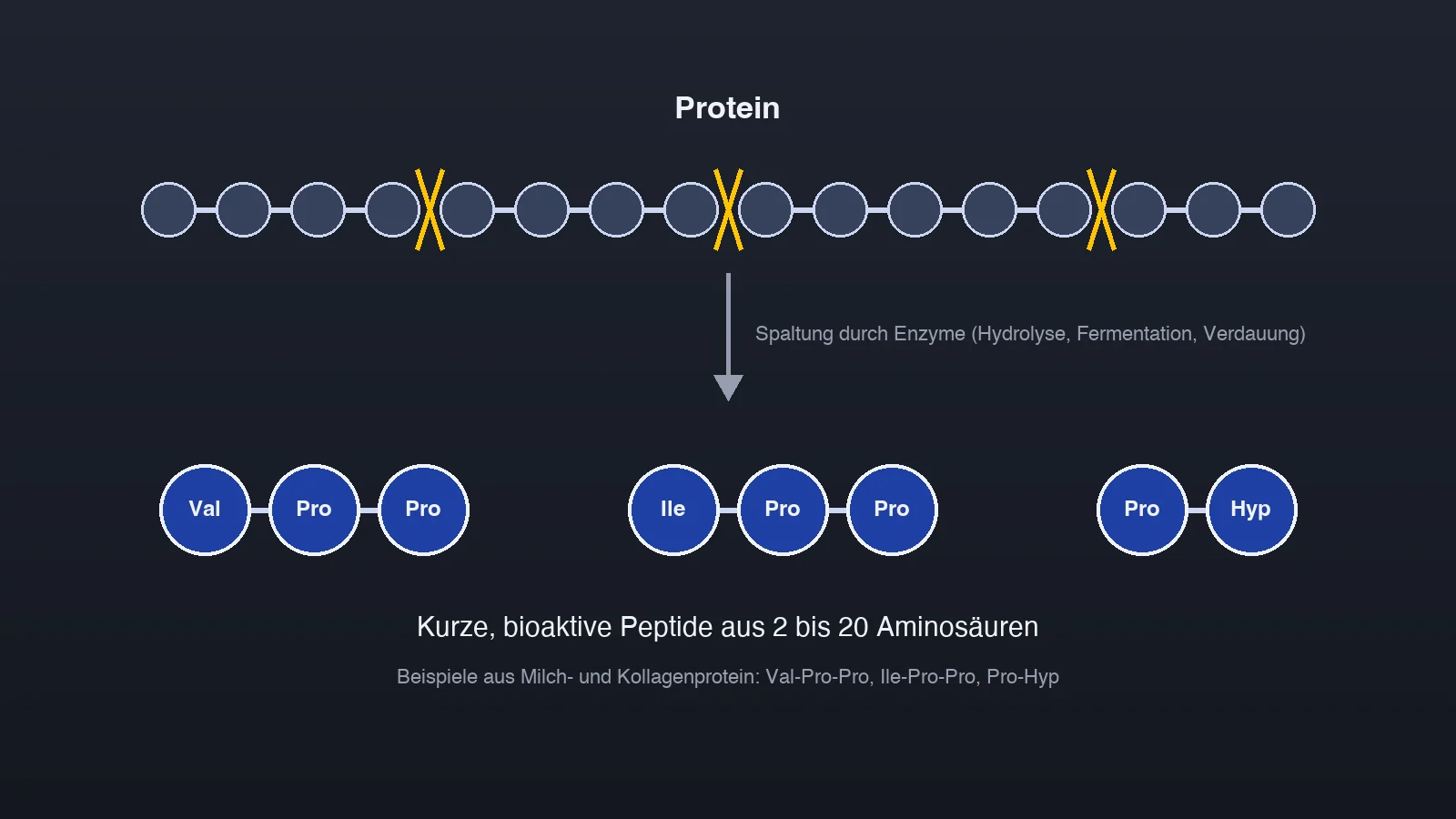
- Many bioactive peptides are fragments of larger proteins. Enzymes cut them out of their precursor.
- In the organism, peptides form in three ways: at the ribosome, by cleavage of proteins, and by enzymes without a ribosome.
- In the lab, peptides are now almost always made by chemical synthesis, usually solid-phase synthesis.
- Whether and how a peptide acts is a subject of research. Alpenpeptid research peptides are intended for laboratory research only.
Definition: what are bioactive peptides?
A peptide is a chain of amino acids joined by peptide bonds. Short chains of up to about 20 amino acids are called oligopeptides, longer ones polypeptides. From about 50 amino acids, the usual term is protein. The basics are explained in What are peptides?
“Bioactive” does not describe a chemical property but an observation: the peptide changes a measurable process in a test or model system. Typical readouts are binding to a receptor, inhibition or activation of an enzyme, or binding of a metal ion. So a peptide is always bioactive with respect to a particular system, not in itself.
What the term means in research
In the literature the term appears in two contexts:
- Endogenous signalling peptides: peptide hormones, neuropeptides and their fragments, which the organism makes itself. Research often uses them as templates for synthetic analogues.
- Peptides from food proteins: fragments released from proteins in milk, soy, fish or cereals during digestion or fermentation. The usual question here is which fragments form and what activity they show in a test.
The term biopeptides is often used as a synonym, especially for peptides from food proteins. There is no single agreed definition. So when comparing literature, always look at the sequence, not the collective name.
Peptide formation: how peptides arise
The peptide bond
A peptide bond forms when the carboxyl group of one amino acid reacts with the amino group of the next. A molecule of water is released, which makes it a condensation reaction. The resulting amide bond is stable and partly rigid, and gives the chain’s backbone its shape. More in the glossary under peptide bond.
Three routes in the organism
| Route | What happens | Example |
|---|---|---|
| Ribosomal synthesis with processing | The ribosome makes a precursor protein, and enzymes cut the active peptides out of it. | Proopiomelanocortin, which gives rise to ACTH and α-MSH |
| Cleavage of proteins | Proteases break proteins into short fragments, for example during digestion. | Tripeptides from milk protein such as VPP and IPP |
| Non-ribosomal synthesis | Dedicated enzymes join amino acids directly, without a ribosome or mRNA. | Glutathione, made in two enzymatic steps |
The first route shows why so many bioactive peptides are fragments: the organism stores them as part of a larger protein and releases them when needed. A single precursor can give rise to several peptides with different roles.
Peptide formation in the lab
For research, peptides are almost always made chemically. The standard method is solid-phase peptide synthesis (SPPS), described by Bruce Merrifield in 1963. The chain grows on a resin, one amino acid at a time. Protecting groups prevent unwanted reactions. At the end the peptide is cleaved off, purified by HPLC and freeze-dried.
Chemical synthesis has two advantages: the sequence is fixed exactly, and building blocks that do not occur in nature can be added, such as D-amino acids or an acetyl group at the start of the chain. Typical by-products are deletion sequences, chains with a missing or doubled amino acid. That is why purity and identity should be checked for every lot, as described in HPLC and mass spectrometry.
Natural templates for research peptides
Many research peptides go back to sequences first found in tissue, blood or body fluids. Some examples from the range:
| Peptide | Length | Natural template |
|---|---|---|
| GHK-Cu | 3 amino acids | The tripeptide Gly-His-Lys was isolated from human plasma in 1973. It binds copper(II) tightly. |
| KPV | 3 amino acids | The three C-terminal amino acids of α-MSH |
| Glutathione | 3 amino acids | Endogenous tripeptide of glutamate, cysteine and glycine, with an unusual γ-linkage |
| BPC-157 | 15 amino acids | Partial sequence of a protein described in gastric juice |
| TB-500 | 7 amino acids in the common form | Derived from a section of thymosin β4 |
| Epithalon | 4 amino acids | Synthetic tetrapeptide, developed after studies of a pineal gland extract |
| ACTH 1-39 | 39 amino acids | Peptide hormone from proopiomelanocortin |
These peptides are not natural extracts but are made synthetically. The sequence matches the natural template or is deliberately changed. Sequence, molecular formula and molecular mass are on every product page.
Natural sequence, fragment or analogue?
To place a peptide, it helps to ask how close it is to its template:
- Natural sequence: identical to the endogenous peptide, such as glutathione or ACTH 1-39.
- Fragment: a section of a larger peptide or protein, such as KPV from α-MSH.
- Analogue: a changed sequence with exchanged or modified building blocks, often to slow breakdown by proteases. Examples are semaglutide and tirzepatide.
Short natural peptides are often broken down quickly in the organism and in cell culture media. Half-life is therefore one of the most important figures when planning experiments. Modifications such as acetylation, amidation or lipidation change it deliberately.
Studying bioactive peptides in the lab
Working with bioactive peptides above all requires certainty about the identity of the material. A single exchanged amino acid can change activity in a test completely. Good practice:
- Check identity: the measured mass in the mass spectrum must match the calculated mass, including all modifications.
- Know the purity: deletion sequences often have a similar mass and can show activity of their own. The HPLC purity figure shows their share.
- Allow for peptide content: for accurate concentrations, the peptide share counts, not the weighed amount. More in Peptide content vs purity.
- Consider stability: short peptides usually dissolve well but are sensitive in solution. Aliquots and cool storage protect them. Guidance is in Storing peptides.
- Record the lot: lot number, certificate and solvent belong in the lab notebook, so results stay comparable.
The certificates of analysis for every lot can be looked up under Verify a lot.
Common questions
What is the difference between bioactive peptides and biopeptides? In practice, none. Both terms describe peptides with measurable biological activity. Biopeptides is used more often for peptides from food proteins.
Are all peptides bioactive? No. Many fragments released when proteins are cleaved show no activity in any test. Whether a peptide is bioactive depends on the system studied.
How does a peptide bond form? Through the reaction of the carboxyl group of one amino acid with the amino group of the next, releasing water. In the organism this happens at the ribosome or through dedicated enzymes, and in the lab by chemical synthesis.
Are research peptides of natural origin? The sequence often goes back to a natural template. But research peptides are made synthetically, not extracted from tissue.
May I use research peptides on humans or animals? No. Alpenpeptid peptides are intended for in vitro laboratory research only and not for use on humans or animals.
For laboratory research use only. Not for use in humans or animals.