← Knowledge · Updated 6 November 2026 · 6 min read
Key points
- Always compare research peptides by price per milligram, not price per vial.
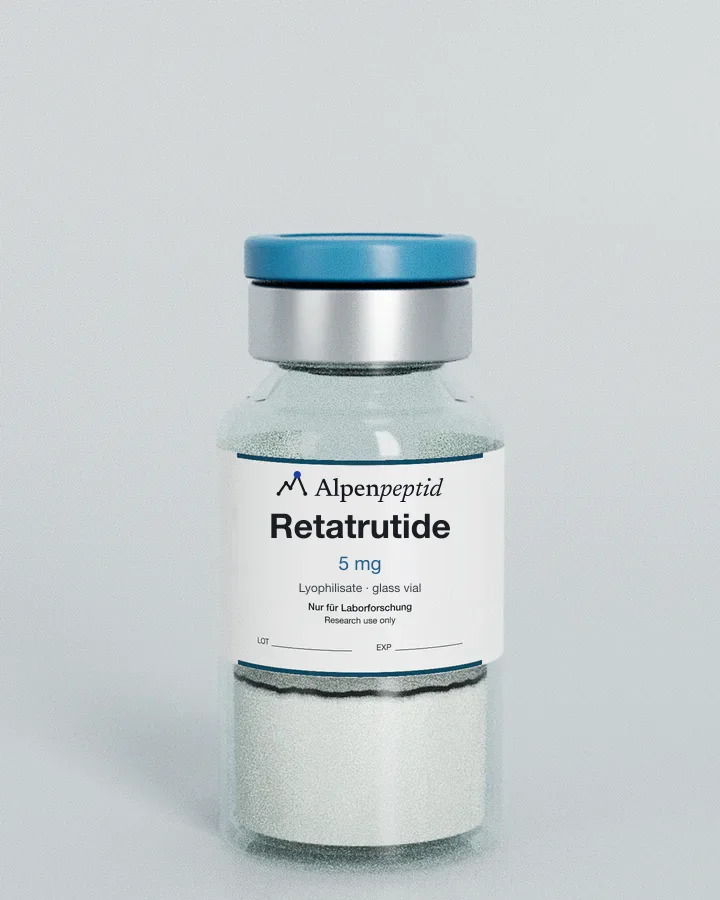
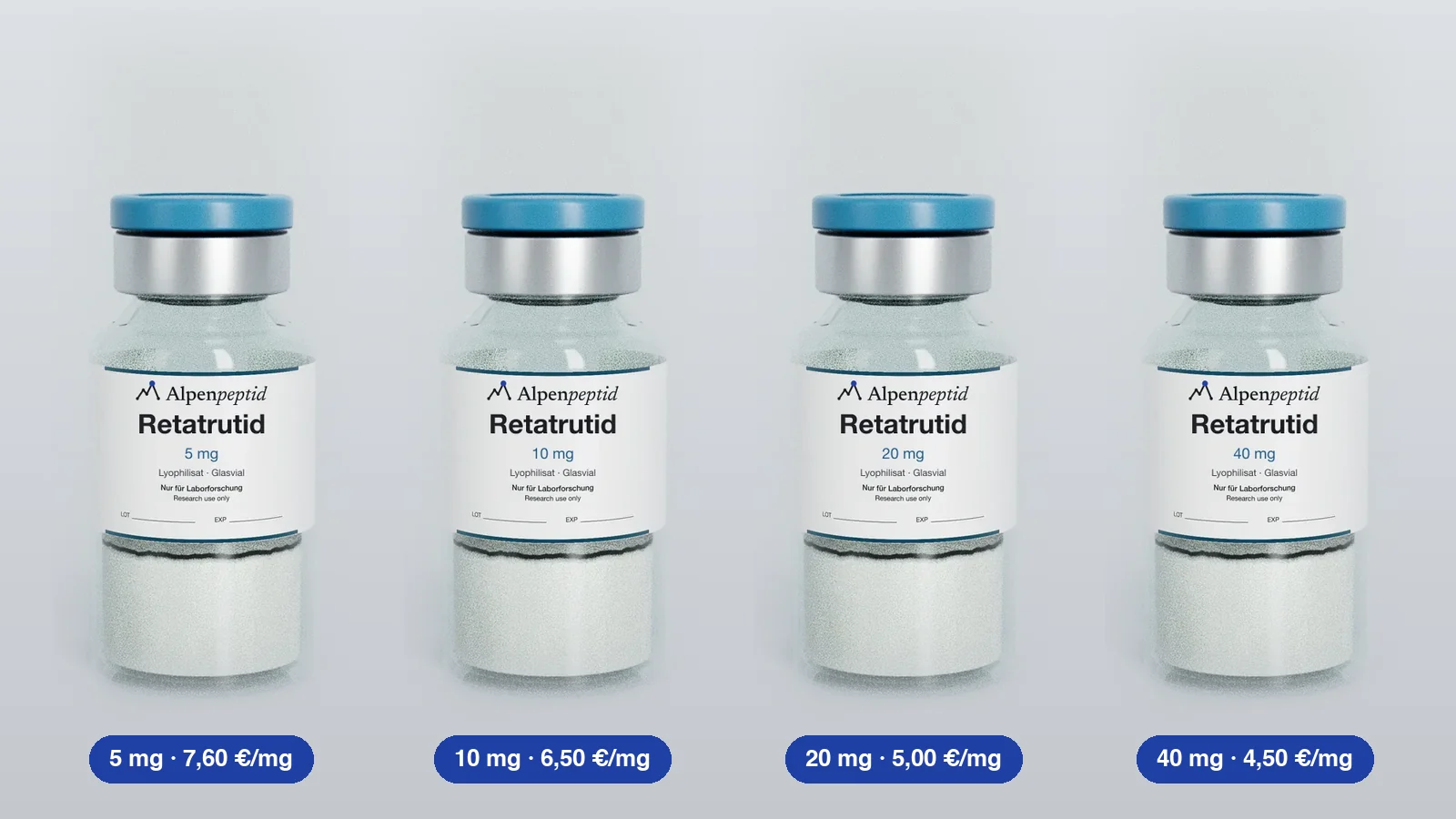
- Larger vials usually cost less per mg. For retatrutide at Alpenpeptid, the price falls from €7.60/mg in the 5 mg vial to €4.50/mg in the 40 mg vial.
- Price per mg refers to the lyophilisate. The peptide content shows how much pure peptide it holds.
- Shipping, the minimum order and discounts belong to the final price. Only the total makes offers comparable.
- A strikingly low price without a certificate of analysis is not a good deal but a risk to your experiments.
Why the vial price misleads
Shops offer the same substance in different fill amounts: 2 mg, 5 mg, 10 mg or more. A €25 vial looks cheaper than a €40 one, but can cost much more per milligram. Comparing only vial prices means comparing pack sizes, not prices.
That is why price per mg is the only fair basis for comparison. Reputable shops show it for every size, without asking you to register. At Alpenpeptid it is on every product card and for every size on the product page.
Calculating price per mg
The calculation is simple:
price per mg = vial price ÷ declared amount in mg
An example from the Alpenpeptid range, as of 7 November 2026:
| Size | Price | Price per mg |
|---|---|---|
| Retatrutide 5 mg | €37.99 | €7.60/mg |
| Retatrutide 10 mg | €64.99 | €6.50/mg |
| Retatrutide 20 mg | €99.99 | €5.00/mg |
| Retatrutide 40 mg | €179.99 | €4.50/mg |
The largest vial costs about 40% less per mg than the smallest. Current prices are always on the retatrutide product page and in the peptide catalogue, where you can also sort by price and filter by pack size.
Allowing for peptide content
Price per mg refers to the declared amount of lyophilisate. Besides the peptide, that includes counterions and residual water. The peptide content says how much of it is actually peptide. For peptide salts it is often between about 60 and 90%.
When you compare two offers with known peptide content, you can work out the net price:
price per mg of peptide = price per mg ÷ peptide content
At €4.50/mg and a peptide content of 80%, that gives €5.63 per mg of pure peptide. An apparently cheaper offer with lower peptide content can end up costing more. Why purity and peptide content are different things is explained in Peptide content vs purity.
Keeping the total cost in view
A fair comparison does not stop at the product price. These items belong to it:
- VAT: are prices end prices including VAT, or is it added at checkout? At Alpenpeptid all catalogue prices are end prices.
- Shipping: what does shipping cost, and from what goods value is it free? At Alpenpeptid shipping within Germany costs €4.99 and is free from €250, and from €350 to the rest of the EU.
- Minimum order: if your cart is below it, you have to add more. At Alpenpeptid it is €200.
- Discounts: discounts for certain payment methods or larger quantities change the final price. Alpenpeptid gives 10% off the goods value when paying with Bitcoin.
A worked example with a cart of retatrutide 40 mg, BPC-157 10 mg and bacteriostatic water 10 ml, delivered to Germany:
| Item | SEPA transfer | Bitcoin |
|---|---|---|
| Goods | €229.97 | €229.97 |
| Discount | – | −€23.00 |
| Shipping | €4.99 | €4.99 |
| Total | €234.96 | €211.96 |
Checkout calculates this automatically once you choose a country and payment method, so you see the final amount before you submit.
What a very low price can mean
Synthesis, HPLC purification and independent analysis cost money. A price well below the market level can indicate savings at one of these steps. Typical results are lower purity, lower peptide content or an amount below what the label states.
For lab work that costs more than any price difference: an experiment with unsuitable material has to be repeated. So before buying, check that every lot comes with a certificate of analysis giving method and testing lab. How to tell is described in Buying peptides: how to identify a reputable supplier.
Choosing the right size
The largest vial is cheapest per mg, but not always the best choice. What matters is how quickly you use the contents:
- As a lyophilisate, a large vial keeps for a long time while it stays dry, cool and unopened.
- In solution, peptides are much less stable. So dissolve a large vial completely and freeze it in aliquots rather than opening it repeatedly.
- For only a few experiments, a smaller vial can be more economical if part of the large one would otherwise go unused.
How to store peptides properly is shown in Storing peptides.
Checklist: finding the best peptide shop for your lab
The best peptide shop is not the cheapest but the one with the best balance of price per mg and checkable quality. These points help with the comparison:
| Criterion | How you recognise it |
|---|---|
| Price per mg | Visible for every size, without logging in |
| End prices | VAT included, shipping costs stated openly |
| Analysis | Certificate of analysis per lot, with method, lab and date |
| Lot link | Lot number identical on vial and certificate |
| Substance data | Sequence, molecular formula and molecular mass with a source |
| Reachability | Imprint, address and an email that gets answered |
Common questions
Why is the larger vial cheaper per mg? Filling, labelling, analysis and shipping cost roughly the same per vial, whatever the amount. With larger fill amounts these costs spread across more milligrams.
Is the cheapest supplier also the best? Not necessarily. Without a certificate of analysis there is no way to check that amount, purity and identity are right. A slightly higher price with documented quality is usually the better choice for reproducible experiments.
How do I compare mixes with single peptides? Divide the price of the mix by the total amount of all components and compare with the single peptides in the same amounts. More on this in Peptide mixes in one vial.
Do I have to calculate price per mg myself? No. At Alpenpeptid the price per mg is shown for every size. In the catalogue you can also sort by price and filter by price range and pack size.
For laboratory research use only. Not for use in humans or animals.